For years, St. Louis has enjoyed a reputation as one of the most affordable major metropolitan areas in the country. But if you’ve been shopping for a home recently, you might be wondering whether that reputation still holds true.
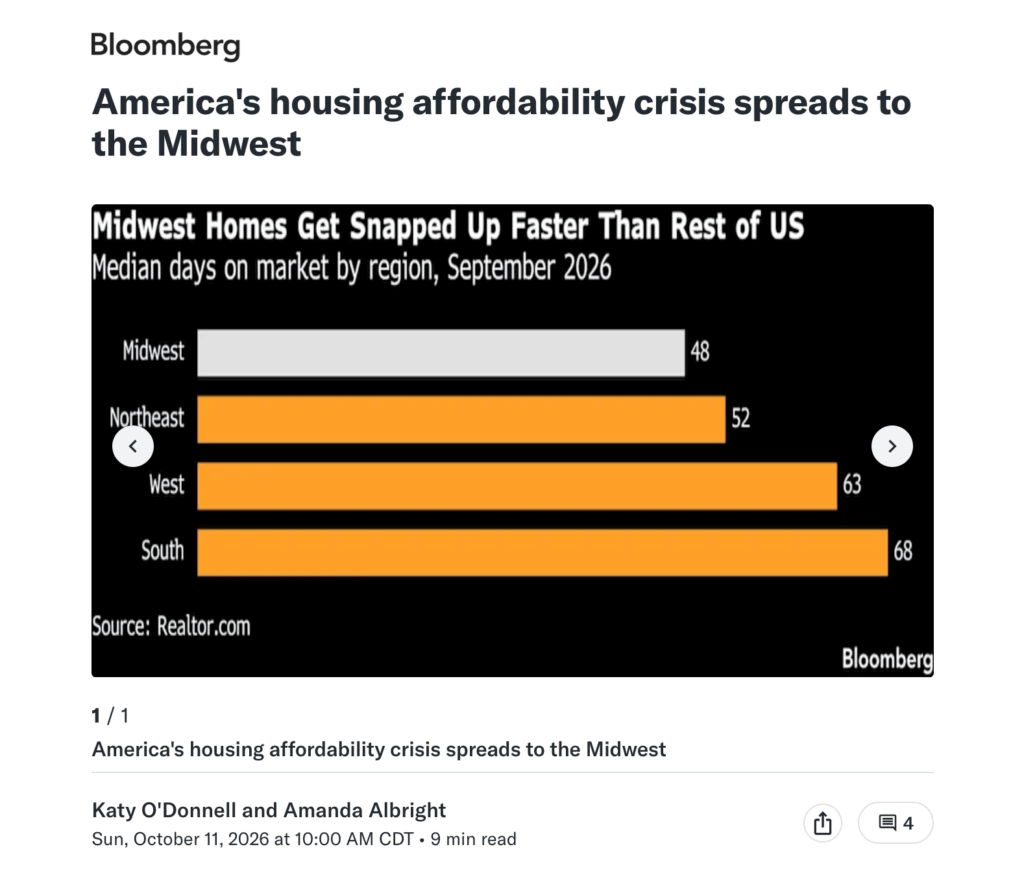
I recently spoke with Bloomberg News reporters Katy O’Donnell and Amanda Albright about the changing housing market in St. Louis. Their October 11, 2026, article, America’s Housing Affordability Crisis Spreads to the Midwest, examines how rising home prices, mortgage rates, and the overall cost of homeownership are making it increasingly difficult for Americans to purchase homes, even in traditionally affordable Midwestern cities.
After 15 years working in St. Louis real estate, I’ve witnessed these changes firsthand. And while the headlines paint a challenging picture, there’s more to the story, particularly for buyers willing to approach today’s market strategically.
Here’s what buyers and sellers should understand about housing affordability in St. Louis in 2026.
Read the full Bloomberg News article, published through Yahoo Finance:
America’s Housing Affordability Crisis Spreads to the Midwest
Is St. Louis Still an Affordable Place to Buy a Home in 2026?
Yes, St. Louis remains relatively affordable compared with many major U.S. cities, but buying a home has become considerably more expensive for local residents.
That’s an important distinction, and one I emphasized when speaking with Bloomberg.
As I explained in the article:
“Everything is relative. While St. Louis is way more affordable than the coastal cities as a major metro area in the US, it has deteriorated somewhat for local buyers.”
Someone relocating from San Francisco, Seattle, or New York may look at St. Louis home prices and see tremendous value.
But someone who has lived and worked in St. Louis for years may have a completely different perspective.
The challenge isn’t necessarily how St. Louis compares with other cities. It’s how local home prices compare with local incomes.
And that relationship has changed substantially over the past several years.
Why Are Home Prices Increasing in St. Louis and Across the Midwest?
Home prices across the Midwest have increased significantly since the pandemic, driven in part by limited housing inventory, continued demand, and homeowners choosing to stay in properties with historically low mortgage rates.
The Bloomberg article highlights several statistics that illustrate the affordability challenges facing the region.
According to the report:
- Median listing prices per square foot across the Midwest increased 59.6% from pre-pandemic levels through September 2026.
- Private-sector wages in the Midwest increased approximately 30% between the second quarter of 2019 and the second quarter of 2026.
- By July 2026, more than half of approximately 200 Midwestern metropolitan areas were considered unaffordable under the Federal Reserve Bank of Atlanta’s affordability measure.
In other words, housing prices have increased considerably faster than wages.
St. Louis hasn’t been immune to these changes.
The Bloomberg article also references data from the Mid America Regional Information Systems (MARIS), showing that single-family homes in St. Louis reached their least affordable level in July 2026 since at least 2006, before improving slightly in August.
One of the challenges is that many homeowners who purchased or refinanced when mortgage rates were around 3% have little financial incentive to sell.
Moving to another home often means taking on a significantly higher interest rate, even if the new property isn’t substantially more expensive.
That reluctance to move limits the number of available homes, which can help support prices even when buyer demand slows.
How Are Higher Mortgage Rates Affecting St. Louis Homebuyers?
Higher mortgage rates have significantly increased monthly payments, making buyers more cautious about how much they’re willing to spend on a home.
This is one of the biggest changes I’ve noticed while working with buyers.
As I told Bloomberg, today’s buyers are:
“way more payment-conscious”
And understandably so.
Consider a buyer purchasing a $300,000 home with a 20% down payment and a 30-year fixed-rate mortgage.
At a 3% interest rate, the monthly principal and interest payment would be approximately $1,012.
At a 7% interest rate, that same payment increases to approximately $1,597.
That’s nearly $585 more per month for the exact same house, before accounting for property taxes, homeowners insurance, or maintenance.
And those additional expenses have also increased.
The result is that buyers who might have comfortably afforded a particular home several years ago are now reconsidering what makes financial sense.
I’m seeing more buyers focus on their actual monthly housing expenses rather than simply purchasing at the maximum price for which they’ve been preapproved.
Frankly, that’s a sensible approach.
Is 2026 a Good Time to Buy a House in St. Louis?
For buyers who are financially prepared and plan to stay in their homes for several years, 2026 can still present opportunities, particularly in portions of the market experiencing reduced competition.
For anyone considering buying a home in St. Louis, understanding current market conditions and negotiating opportunities is especially important
Higher mortgage rates have certainly made purchasing more expensive, but they’ve also changed the competitive landscape.
During the height of the pandemic housing market, buyers frequently faced multiple offers, waived contingencies, and had very little room to negotiate.
While competition remains strong for certain homes and neighborhoods, that isn’t necessarily the experience across the entire St. Louis market today.
I’m seeing opportunities for buyers to negotiate on properties that have been sitting on the market, particularly when sellers have priced their homes too aggressively.
Depending on the property and circumstances, buyers may have opportunities to negotiate:
- A lower purchase price.
- Seller contributions toward closing costs.
- Repairs or credits following inspections.
- More favorable contract terms and closing timelines.
Of course, these opportunities vary considerably by neighborhood, price range, and property condition.
A well-maintained, appropriately priced home in a desirable location can still attract multiple offers.
But buyers shouldn’t assume that every property requires an aggressive offer or that they need to waive important protections to purchase a home.
The key is understanding the specific market for the property you’re considering.
Will Home Prices in St. Louis Drop in 2026 or 2027?
There is no reliable way to predict whether St. Louis home prices will decline broadly, and conditions can vary significantly between neighborhoods and price ranges.
One of the most common questions I hear from buyers is whether they should wait for prices to come down.
It’s a reasonable question, particularly given how much homeownership costs have increased.
However, lower buyer demand doesn’t automatically translate into falling home prices.
In St. Louis, limited inventory continues to be an important factor.
When fewer homeowners are willing to sell, the supply of available properties can remain relatively tight, even as higher mortgage rates reduce the number of active buyers.
That can help stabilize prices.
It’s also important to remember that the St. Louis housing market isn’t one uniform market.
Conditions in neighborhoods like Tower Grove South, Maplewood, Webster Groves, Kirkwood, and Chesterfield can vary considerably. Exploring individual St. Louis neighborhoods can help buyers better understand these differences
Even within the same neighborhood, property condition, updates, layout, and asking price can produce very different results.
Rather than trying to predict exactly where prices or interest rates will be six months from now, I encourage buyers to focus on whether a particular home makes sense for their financial situation and long-term plans.
What Does the Housing Affordability Crisis Mean for St. Louis Home Sellers?
Today’s St. Louis home sellers need to pay closer attention to pricing, property condition, and the financial pressures facing potential buyers.
While limited inventory continues to benefit sellers in many situations, buyers are increasingly sensitive to the total cost of purchasing and maintaining a home.
That means a property requiring significant repairs or updates may face more resistance than it would have several years ago.
Buyers are looking beyond the asking price and considering expenses such as:
- Roof, HVAC, and other major system replacements.
- Property taxes and homeowners insurance.
- Necessary repairs and deferred maintenance.
- Utility costs and ongoing upkeep.
For sellers, this makes accurate pricing particularly important.
A home priced appropriately based on recent comparable sales and its condition can still generate strong interest.
But pricing a property based solely on what a neighbor received during a more competitive market can be problematic.
Today’s buyers have more financial constraints, and many are willing to walk away from properties they believe are overpriced.
For homeowners considering selling a home in St. Louis, understanding current market conditions and setting a realistic asking price are essential.
Why Is Housing Affordability Becoming a Bigger Problem Across the Midwest?
The Midwest has historically offered lower home prices than many coastal markets, but rising prices and borrowing costs are making homeownership less attainable for local households.
This is the central issue explored in the Bloomberg article.
For years, Midwestern cities offered a relatively accessible path to homeownership.
But the combination of rising property values, higher mortgage rates, and wages that haven’t kept pace with housing costs has changed that equation.
The article highlights challenges in several metropolitan areas, including Kansas City, Milwaukee, Chicago, and St. Louis.
What’s particularly interesting is that the Midwest is experiencing these pressures while portions of the South and West have seen home prices soften.
The difference is partly related to housing supply.
Some Sun Belt markets experienced substantial new construction during the pandemic years. As those homes become available, additional inventory can help moderate prices.
Many Midwestern communities haven’t experienced the same level of new construction.
That leaves buyers competing for a relatively limited supply of existing homes.
And while St. Louis continues to offer more affordable options than many major metropolitan areas, the availability of homes within reach of local buyers remains an important concern.
What Should First-Time Homebuyers Know About the St. Louis Housing Market?
First-time buyers should focus on their monthly budget, understand the full cost of homeownership, and evaluate opportunities based on individual properties rather than national housing headlines.
For someone purchasing their first home, today’s market can feel intimidating.
Higher mortgage rates, rising insurance premiums, and increased property values have made the financial commitment more significant.
However, there are still opportunities for buyers who approach the process with realistic expectations.
I encourage first-time buyers to establish a comfortable monthly payment before beginning their home search.
That number should account for more than principal and interest. Property taxes, homeowners insurance, utilities, maintenance, and potential repairs should all be part of the equation.
It’s also important to understand that asking prices aren’t always final sale prices.
Depending on the property, there may be opportunities to negotiate terms that make a purchase more financially manageable.
And while no one can guarantee where mortgage rates will go, purchasing a home should make financial sense based on today’s numbers rather than the hope of refinancing at a lower rate in the future.
If you’re considering purchasing your first home, reviewing the homebuying process in St. Louis is a good place to start.
What Did Bloomberg Report About the St. Louis Housing Market?
Bloomberg’s October 11, 2026, article, America’s Housing Affordability Crisis Spreads to the Midwest, examines how rising housing costs are affecting buyers throughout the region.
The article includes perspectives from buyers, economists, and real estate professionals across several Midwestern cities.
I was pleased to contribute my observations about the St. Louis market, particularly the growing emphasis buyers are placing on monthly payments and the difference between national perceptions of affordability and the realities facing local residents.
The article also includes commentary from St. Louis REALTORS® President Sam Hall about the increasing prices buyers are encountering in communities such as Maplewood.
It’s a worthwhile read for anyone interested in how housing affordability is changing, both nationally and here in St. Louis.
Read the full Bloomberg News article, published through Yahoo Finance:
Final Thoughts: Is Buying a Home in St. Louis Still Worth It?
After 15 years helping people buy and sell homes throughout St. Louis, I’ve seen our market change considerably.
There’s no question that purchasing a home has become more expensive.
But I also believe it’s important to look beyond the headlines.
Higher mortgage rates and affordability challenges have created a more complicated housing market, but they’ve also reduced competition in certain segments and created opportunities that weren’t available when buyers were routinely competing against numerous offers.
For sellers, understanding today’s buyers and pricing appropriately is more important than ever.
For buyers, the focus should be on finding a home that meets their needs, fits their budget, and makes sense for their long-term plans.
St. Louis remains a wonderful place to call home, with distinctive neighborhoods, historic architecture, walkable communities, and a wide variety of housing options.
The challenge is making sure homeownership remains attainable for the people who already live and work here.
And that’s a conversation worth having.
Dan Brassil is a full-time St. Louis real estate agent with RedKey Realty Leaders. With 15 years of experience helping buyers and sellers throughout the St. Louis metropolitan area, Dan specializes in historic homes, established neighborhoods, and helping clients make informed real estate decisions without pressure or hype.

Leave a Reply